Overview
Good and Evil players share a table but have different goals. Teams go on quests, while Merlin tries to help Good without becoming an obvious assassination target.
Edition scope. Original The Resistance: Avalon. Start with Merlin and the Assassin plus ordinary Good/Evil roles. Optional roles are outlined below; Lady of the Lake, plot cards, and Big Box variants are not included.
Key terms / 关键词. quest (任务); Leader (队长); approve/reject (同意/反对组队); Good/Evil (好人/坏人阵营); Merlin (梅林); Assassin (刺客)
Objective
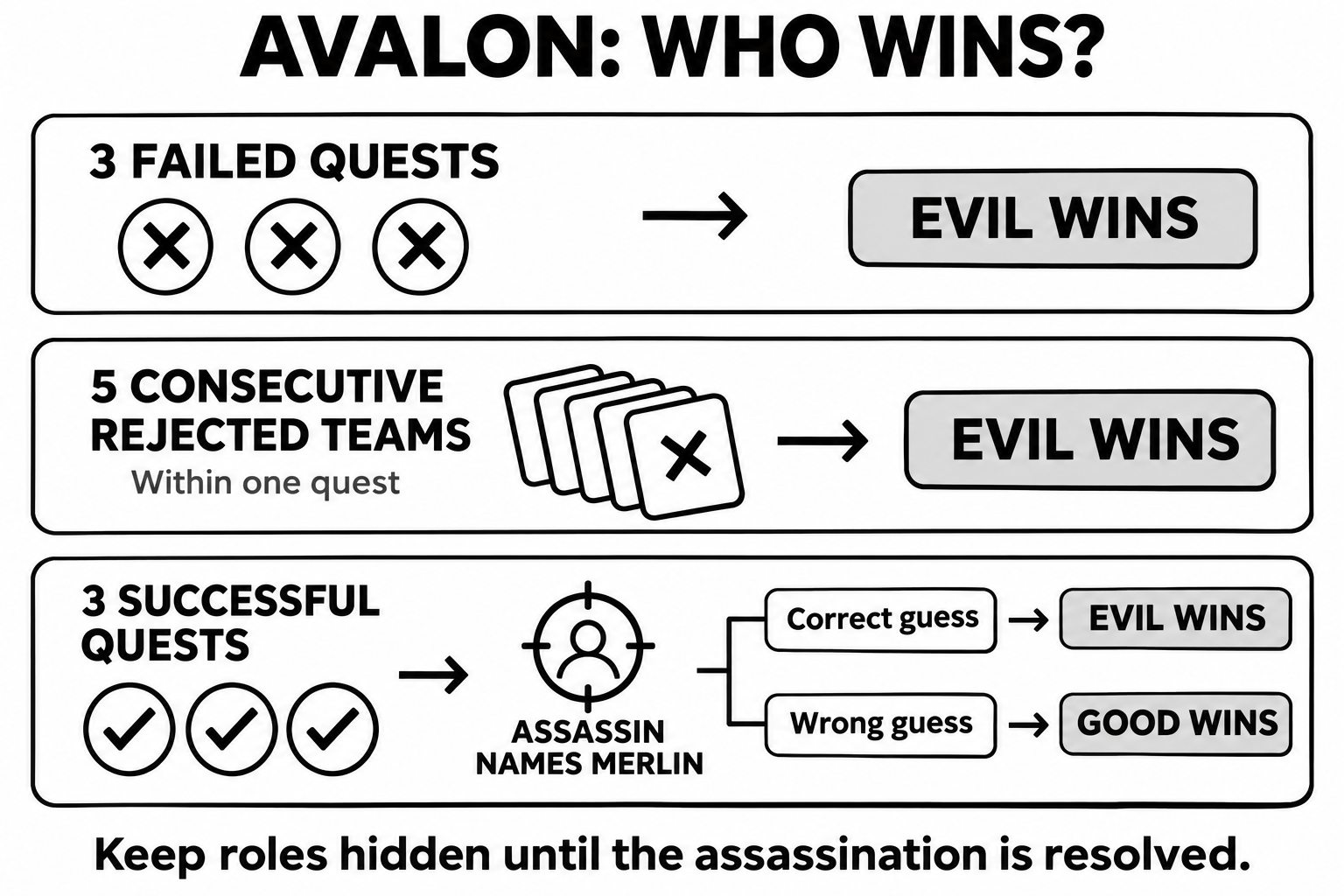
Good needs three successful quests and Merlin to survive the final assassination. Evil wins through three failed quests, five consecutive rejected teams, or correctly identifying Merlin after Good’s third success.
Setup
- Use the player-count table below. Deal one secret role each: include Merlin among Good and the Assassin among Evil. Ordinary roles fill the other slots.
- Give everyone Approve and Reject vote tokens. Put the quest marker on Quest 1, prepare Success/Fail cards and result markers, and choose the first Leader randomly.
- Run the opening information phase for your exact roles. For the basic setup: everyone closes eyes; Evil opens eyes to recognize each other, then closes them; Evil raises thumbs with eyes shut; Merlin opens eyes to identify them, then closes eyes; thumbs down; everyone opens eyes.
How to play
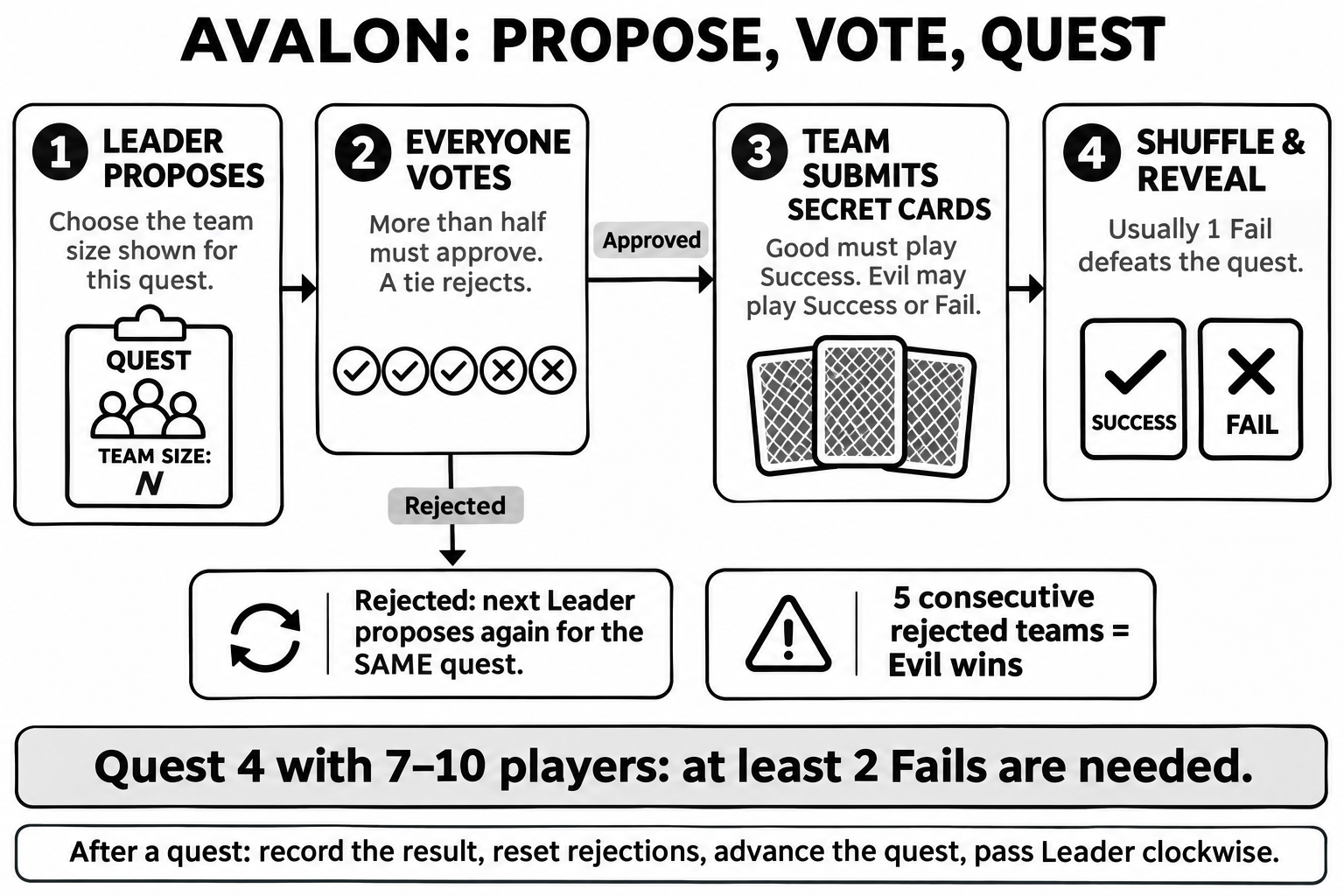
Leader proposes a team → everyone votes → approved members submit quest cards → record result → next Leader. After three successes, resolve the assassination.
Propose a team
The Leader chooses exactly the required number of different players for this quest. The Leader may include themselves but does not have to. Discuss the proposed team.
Vote on the team
Everyone, including the Leader and players not selected, reveals Approve or Reject together. More than half must approve. A tie rejects. On rejection, move the Leader clockwise and propose again for the same quest; five consecutive rejections make Evil win.
Run the quest
Only the approved team submits one hidden quest card each. Good must submit Success; Evil may submit Success or Fail. Shuffle the submitted cards before revealing, and keep unused cards separate and hidden.
Record and continue
Normally any Fail defeats the quest. Exception: Quest 4 with 7–10 players requires at least two Fails. After a quest, reset the rejection count, advance the quest marker, and move the Leader clockwise unless a winning condition ends play.
Player counts and quest team sizes
| Players | Good / Evil | Q1 | Q2 | Q3 | Q4 | Q5 |
|---|---|---|---|---|---|---|
| 5 | 3 / 2 | 2 | 3 | 2 | 3 | 3 |
| 6 | 4 / 2 | 2 | 3 | 4 | 3 | 4 |
| 7 | 4 / 3 | 2 | 3 | 3 | 4* | 4 |
| 8 | 5 / 3 | 3 | 4 | 4 | 5* | 5 |
| 9 | 6 / 3 | 3 | 4 | 4 | 5* | 5 |
| 10 | 6 / 4 | 3 | 4 | 4 | 5* | 5 |
* Quest 4 at 7–10 players needs two Fail cards. Every other quest needs only one.
Optional roles: change the opening script
| Role | Information |
|---|---|
| Percival / 派西维尔 | Good. Sees Merlin; with Morgana, sees both without knowing which is Merlin. In a five-player game, the rules advise adding Mordred or Morgana when using Percival. |
| Morgana / 莫甘娜 | Evil. Appears alongside Merlin to Percival. |
| Mordred / 莫德雷德 | Evil. Hidden from Merlin, but recognizes the other Evil players except Oberon. |
| Oberon / 奥伯伦 | Evil. Does not see the other Evil players, and they do not see Oberon. Merlin still sees Oberon. |
With optional roles: Evil recognition excludes Oberon; Merlin sees all Evil except Mordred; then Merlin and Morgana show themselves to Percival. Everyone closes eyes between phases. Use the full rulebook script before hosting these roles.
Worked example
Seven players, Quest 4: four people submit Success, Success, Success, Fail. The quest succeeds, because this particular quest needs two Fails. The same single Fail would defeat Quest 1, 2, 3, or 5.
Ending & scoring
Three failed quests or five consecutive rejected teams immediately give Evil the win. After three successful quests, do not reveal roles yet. Evil discusses, then the Assassin names one Good player as Merlin. A correct guess makes Evil win; a wrong guess makes Good win. Players stay involved throughout normal quest play; there is no routine player elimination.
Rules to double-check
- Approving a team is a public vote by everyone; quest cards are secret submissions by selected members only.
- A successful quest does not prove every member is Good: Evil can choose Success.
- Five rejected proposals are consecutive within the same quest, not five across the whole game.
- Do not reveal Merlin after the third successful quest until the assassination is resolved.
Player tips / 玩家建议
Beginner suggestions based on the rules, not guaranteed winning moves. DMs can share these with the whole table before play.
- Track teams and votes. Compare who joined failed quests and how proposals changed; confidence alone is not evidence.
- Merlin: guide without announcing certainty. Explain public clues so your knowledge is less obvious.
- Ordinary Good: help protect Merlin. Reason from the shared evidence and avoid forcing players to reveal special roles.
- Evil: a Success can buy trust. Consider the quest score and team composition before automatically playing Fail.
Sources & edition notes
Indie Boards & Cards · original Avalon rulebook (mirror) ↗
Names follow the supplied On Board catalogue. Edition details may differ.
Box artwork: Indie Boards & Cards · via Mox Boarding House. Image source ↗. Artwork belongs to its respective rights holders; packaging may vary by edition.
Rules sources checked on 13 November 2026. Teaching scripts and practice tasks are suggested hosting aids. The publisher’s rules and the edition in the box remain the reference for exceptions.